

A key insight is that more distribution can hide weak demand. A brand can win more doors, ring up more total sales, and still have a shelf problem if shoppers aren’t buying it quickly once it’s stocked. That’s why velocity brand management matters, it helps leaders separate true pull from simple presence and decide whether the brand is healthy at shelf.
For CPG and beverage teams, that distinction changes the growth conversation. Distribution gets attention because it’s visible, but velocity is where efficiency shows up. If a product is carrying more doors without faster movement in those doors, the business can look bigger while getting less productive. A better strategy starts with the question retailers care about most, which products deserve more space because shoppers already prove they’ll move them.
The Growth Trap Most CPG Brands Fall Into
Brands often celebrate distribution wins as if they’re the finish line. More doors feels like progress, and sometimes it is, but distribution by itself doesn’t tell you whether a product deserves the shelf space it’s occupying. A significant trap is confusing availability with demand.
That’s why velocity is such a useful corrective. It forces the brand team to ask whether shoppers are pulling the item through the set or whether the brand is riding on broader placement. In CPG strategy, that distinction matters because shelf space is finite and retailer patience is limited. If your item isn’t moving quickly in the doors you already have, chasing more doors usually amplifies the same problem instead of solving it.
A useful way to think about it is this, distribution gets you into the race, but velocity tells you whether you can keep pace. The brands that grow well understand that shelf presence only creates opportunity. The sale happens when shopper demand, packaging, price, and in-store execution all line up.
Practical rule: if a brand team can’t explain why velocity is soft in its current doors, it’s not ready to scale distribution responsibly.
That mindset is part of broader CPG marketing strategy thinking, where growth comes from alignment across retail execution, shopper demand, and brand building, not from a single lever. Theory House’s CPG marketing strategy perspective fits neatly with that logic, because the shelf only rewards brands that can convert presence into repeatable movement.
Decoding Velocity Brand Management
Think of a brand like a car on a highway system. Distribution is how many roads you’re allowed onto. Velocity is how fast you’re moving once you’re on them. A car that’s on every road but creeping forward isn’t winning, and a brand that’s in many stores but barely selling there has the same problem.
In consumer goods, velocity is a core retail performance metric defined as sales divided by distribution, meaning how quickly a product sells once it is on shelf, according to SPINS’ glossary on velocity. SPINS also notes that industry teams separate velocity from distribution so they can isolate true demand, and that the measurement should change depending on the analysis context. Within a single market, analysts may use sales per point of distribution, or SPPD, while across markets they’re advised to use sales per million dollars of ACV. SPINS’ velocity glossary is a useful anchor for that distinction.
Why the definition matters in practice
If a brand only looks at total sales, it can miss the story. Two products can produce the same sales number and still be very different businesses if one has broad distribution and the other sells fast in fewer doors. One is buying volume with reach. The other is earning volume with demand.
That’s why velocity brand management is more than a measurement exercise. It’s a management discipline that helps teams decide whether they need more doors, better shelf execution, stronger packaging, sharper pricing, or a different promotional plan. Without that lens, a team may keep pushing distribution when the actual issue is conversion at shelf.
A simple way to frame the metric
- Distribution tells you where the item is.
- Velocity tells you how quickly shoppers move it.
- Both together tell you whether growth is being created by reach, by demand, or by a mix of the two.
This is why the term matters most in beverage, spirits, and other crowded CPG categories. Shelf time is expensive, and retailers expect brands to justify the space they take. When velocity rises, it signals that the brand is doing more than occupying a slot. It’s earning it.
The Core KPIs That Drive Brand Velocity
Velocity doesn’t live in isolation. Brand teams need a small set of KPIs that work together so they can diagnose what’s happening at shelf. The point isn’t to stare at one dashboard line. It’s to understand whether the issue sits in shopper demand, distribution reach, or household trial.
The most useful trio is sales velocity, distribution, and household penetration. Sales velocity tells you how fast the product moves in the doors where it’s sold. Distribution tells you how many doors or how much ACV the brand has. Household penetration shows whether enough shoppers are trying the brand in the first place. If one of those is weak, the others can’t fully compensate.
| Brand Velocity Diagnostic Checklist | What It Measures | High Score Suggests | Low Score Suggests |
|---|---|---|---|
| Sales Velocity | How quickly the product sells in the stores that carry it | Strong shopper pull, good shelf productivity, or effective in-store execution | Weak demand, poor shelf conversion, or an assortment issue |
| Distribution | How widely the brand is listed | Retailer confidence and broad availability | Limited reach, weak authorization, or a rollout that hasn’t scaled |
| Household Penetration | How many households buy the brand | Trial is breaking through and the brand is reaching new buyers | The brand isn’t expanding beyond a narrow buyer base |
For a quick framing on how retailers think about performance indicators more broadly, Theory House’s retail performance indicators resource sits in the same practical lane, because retail leadership doesn’t reward a single vanity metric. It rewards a balanced read on what’s selling, where, and why.
How to read the signals
High distribution with low velocity usually points to a shelf problem, not a placement problem. The item is present, but it isn’t moving with enough urgency. That can mean the shelf set is wrong, the price is off, the pack doesn’t stand out, or the shopper doesn’t understand why it belongs in the basket.
Low distribution with high velocity points in the opposite direction. The brand has proof of demand in the doors where it exists, which often strengthens the case for controlled expansion. That’s the kind of signal retailers listen to, because it shows the product already earns its keep.
Diagnostic rule: don’t ask whether the brand is “doing well” until you know which KPI is carrying the weight.
What brand directors should do with the checklist
Use the metrics together, not as separate scorecards. If household penetration is weak, velocity may never scale sustainably because too few shoppers are entering the brand’s buying cycle. If distribution is strong but velocity is soft, the team should focus on shelf execution and activation before asking for more doors. If both are healthy, the brand has a more credible case for expansion.
How to Measure Velocity the Right Way
Averages can be dangerous in retail. A brand can look healthy in one chain, flat in another, and strong in a single region while underperforming elsewhere. That’s why velocity needs to be measured with enough context to show what’s driving the result.
Use the right denominator
SPINS recommends treating velocity as sales divided by distribution, but the useful form of that analysis depends on where you’re comparing performance. Within one market, sales per point of distribution gives you a clean read on shelf productivity. Across markets, sales per million dollars of ACV lets you compare performance on a more consistent basis. That distinction matters because you’re not just measuring volume, you’re measuring efficiency in the context where the brand is sold. SPINS’ velocity glossary lays out that logic clearly.
The strategic point is clear. If you use the wrong denominator, you can misread the business. A brand may look weak when it exhibits strong productivity in a small set of valuable doors, or it may look strong solely because it has broad exposure.
Treat velocity like a diagnosis, not a verdict
Crisp’s guidance on retail velocity makes the core problem explicit, velocity varies by product, region, and chain, which means a single average can hide the underlying issue. Crisp’s retail velocity guidance is especially useful for beverage and spirits brands, where a product can behave very differently by market and store format.
That means the useful question isn’t just whether velocity is up or down. It’s what’s driving it in which doors, regions, and product variations. If one chain is strong and another is weak, the answer may lie in assortment, retailer compliance, or shopper fit rather than in the brand itself.
High-level averages are for board decks. Store-level and chain-level reads are for decisions.
What to look for before making a move
- By chain: see whether performance changes when the retailer context changes.
- By region: look for geographic clusters that show stronger or weaker pull.
- By product variation: check whether flavors, sizes, or pack formats are creating uneven results.
- By door type: compare flagship doors, convenience doors, and other formats separately when the data allows.
That approach keeps teams from overreacting to a weak average or celebrating a misleading one. It also helps protect against the most common brand mistake, changing pricing, packaging, or promotion before understanding where the shelf problem resides. Measurement should make the next decision sharper, not louder.
The Velocity Framework and Playbook for CPG Brands
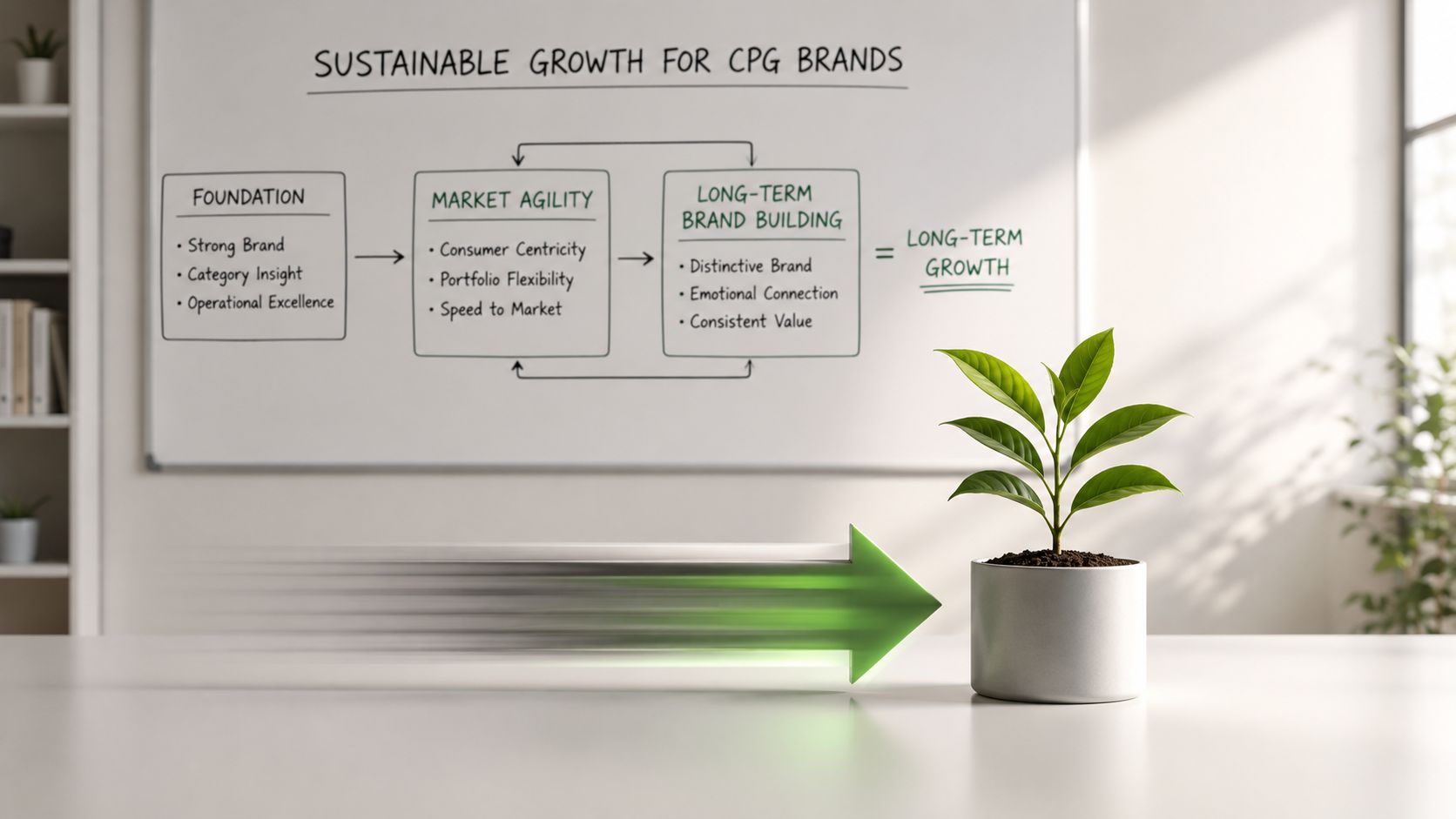
Modern growth planning has to hold two things at once, brand building and sales activation. The marketing velocity idea often called the “two velocities” framework argues that these aren’t substitutes. Brands need both long-term demand creation and short-term conversion pressure, especially now that retail and digital feedback loops are faster than they used to be. That broader shift toward speed and responsiveness is part of why velocity brand management is so relevant today. The marketing velocity discussion captures the strategic point well, growth gets weaker when teams chase only one side of the equation.
Shopper marketing that earns attention
Shopper marketing should do more than decorate the shelf. It needs to make the purchase easier, more obvious, and more urgent. In practice, that usually means sharper point-of-sale materials, cleaner in-store messaging, and promotions tied to clear shopper behaviors rather than blanket discounting.
The mistake is treating every retail touchpoint as a loud signal. Sometimes the best move is a tighter, more precise one, especially when the brand already has reasonable distribution but lacks speed in existing doors. If the item is present and not moving, the issue may be that the shopper still doesn’t understand the reason to choose it today.
Practical rule: if the shelf message can’t be understood in a few seconds, it’s probably not helping velocity.
Retail design that removes friction
Packaging and shelf presence do real work. A brand that disappears into the set makes shoppers work harder, and shoppers usually don’t. Shelf-blocking, stronger facings, and pack hierarchy all help a product earn attention before the price tag does.
That’s why retail design matters to velocity. It creates recognition fast, especially in categories where decisions happen in motion. A package that communicates flavor, occasion, and value quickly can lift shelf productivity because it reduces friction at the exact moment the decision gets made.
Pricing and promotions with restraint
Promotions can lift movement, but they can also train buyers to wait for a deal. That’s the trade-off many teams avoid discussing. Independent growth guidance emphasizes the need for both activation and brand building, because overuse of short-term tactics can weaken longer-term demand and repeat purchase behavior. The challenge is especially sharp in CPG and beverage, where repeated discounting can reset shopper expectations. The gap in many plans is not whether to promote, it’s whether the promotion is building durable habits or just chasing the next scan.
Use discounting with intent. Tie it to trial, launch support, or retailer-specific moments where there’s a clear commercial reason. If every quarter depends on a price cut, the brand can become dependent on it.
Retailer activation that builds confidence
Retailers back brands that help them win. Joint business planning, cleaner data sharing, and sharper retail narratives all strengthen the case for more shelf support. The brand team should come prepared with a view of where the product sells best, what format performs best, and what kind of activation moves the needle.
Theory House’s in-store marketing tactics resource is relevant here because in-store execution is rarely one tactic. It’s a system of cues, placements, and messages that either helps the shopper convert or wastes the opportunity.
The right retailer conversation isn’t “give us more space because we want it.” It’s “here’s where the brand already moves, here’s what we’ve learned, and here’s how more support turns into better productivity for both sides.”
The sustainable growth lens
The most useful velocity playbooks don’t just chase a quick spike. They build repeatable shelf behavior. That means monitoring whether activation supports retention, whether promotions create habit or dependency, and whether the brand is gaining retailer confidence because the data shows real movement, not just temporary lift.
Making Velocity Your Competitive Advantage
Velocity is not a fancy synonym for sales. It’s a way of seeing whether the brand is earning its shelf space through real shopper demand. That’s a more demanding standard, but it’s also a more useful one, because it tells leaders where to fix the business instead of where to celebrate the optics.
The brands that win this way don’t treat distribution as the objective. They treat it as a platform for productivity. They watch where velocity is strong, where it’s weak, and what conditions change the result. Then they adjust packaging, pricing, activation, and retailer conversations around that evidence.
That’s a significant shift in velocity brand management. It moves the team from counting placements to managing shelf performance as a living system. In a crowded CPG market, that mindset is what turns presence into progress and short-term wins into healthier long-term growth.
A CTA for Theory House. If you want to turn shelf data into sharper retail decisions, connect with Theory House and build a velocity plan that helps your brand sell faster in the doors that matter most.