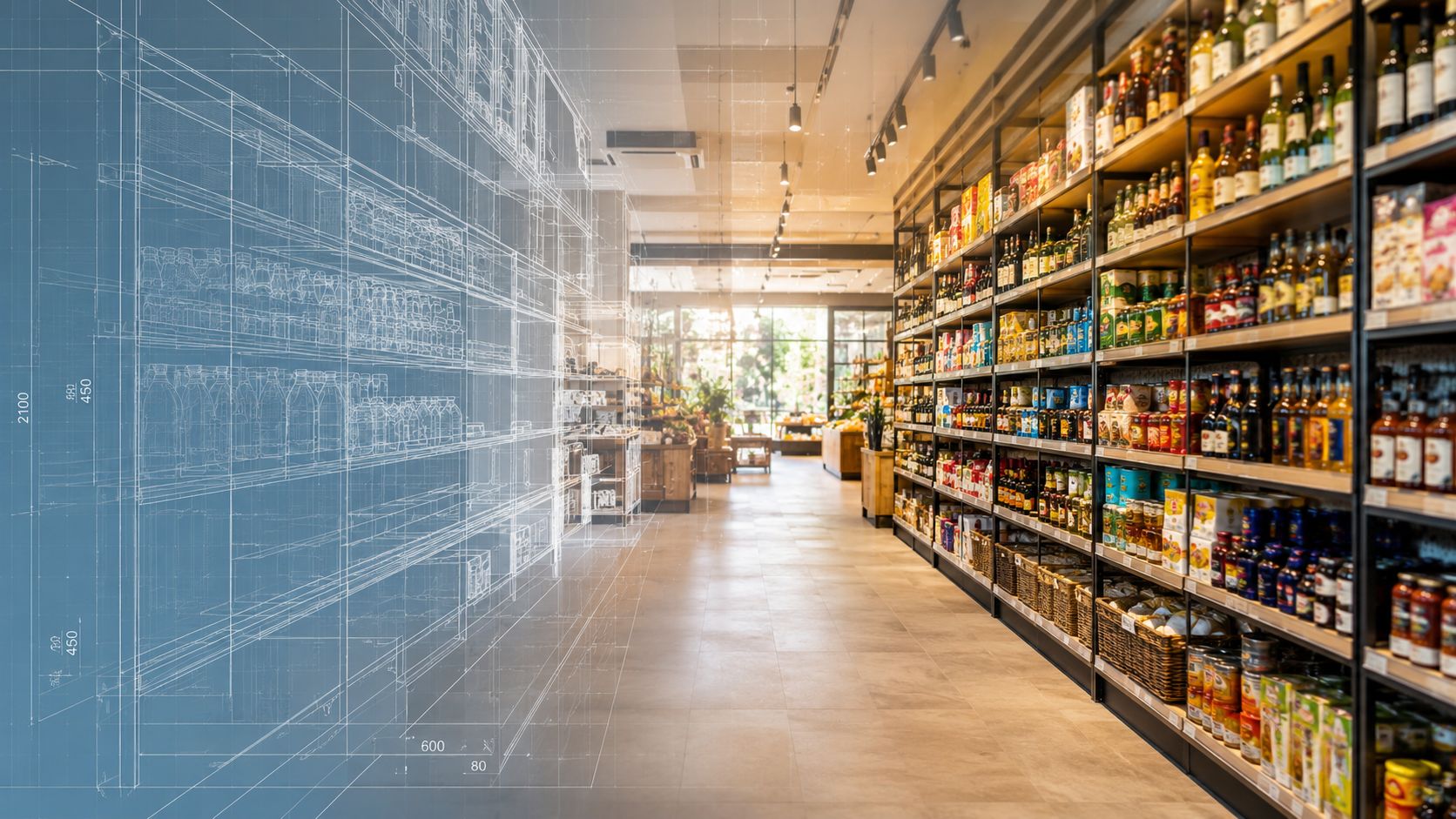
34% of total global CO₂ emissions came from the buildings and construction sector in 2023, alongside 32% of global energy demand and an estimated 2 billion tons of waste annually from construction and demolition activity (Global Alliance for Buildings and Construction). That scale is the right way to think about building for tomorrow in food, beverage, and CPG, because retail brands face the same reality, the future is shaped by what gets designed now, what gets upgraded later, and what gets left to drift.
For a brand director, this isn’t abstract climate language. It’s a retail planning problem. Packaging systems, shelf presence, shopper pathways, and launch calendars all become a kind of infrastructure, and the choices made today harden into tomorrow’s market position. Brands that treat future-proofing as a branding exercise alone usually miss the operational side, where shelf execution, channel mix, and retail readiness either compound or decay.
Why Building for Tomorrow Matters for CPG Brands
The construction sector offers a blunt lesson. Floorspace rose by 5 billion square metres between 2022 and 2023, a 2% increase, and the world now has over 260 billion square metres of built floor area. Those figures are from the Global Alliance for Buildings and Construction, reported in its 2024, 2025 status update on 2023 data. That means the world is still adding capacity at scale while operating in a high-energy, high-waste model. Retail brands repeat the same pattern when they keep funding launches, displays, and channel programs without fixing the structure that supports repeat purchase.
The food and beverage version of a building stock problem is brand asset stock. Most brands do not fail because they lack ideas. They fail because those ideas are not organized into durable systems that survive buyer turnover, planogram resets, and shifting shopper expectations. A future-proof brand needs more than a campaign. It needs a retail-ready operating model that keeps performing when the market changes.
Treat brand planning like infrastructure investment
A practical way to frame building for tomorrow is to ask what gets reinforced. Is the team strengthening core brand cues, retailer trust, and execution consistency, or just adding surface-level novelty? The first path compounds. The second path creates busy work.
The International Energy Agency says buildings consume over one-third of global energy and that in 2022 the sector used about 1% more energy than the year before, with direct CO₂ emissions at 3 Gt and indirect emissions near 6.8 Gt (IEA via the Global ABC report). That same logic applies to retail brands. Operational complexity rises when teams keep layering activity on top of weak foundations. The answer is stronger architecture around assortment, messaging, and shelf conversion.
Retail teams should also work from the future of the channel, not just this quarter’s promotion calendar. Theory House’s view of the future of retail starts with that reality, because the brands that hold up are the ones built to survive changing shopper behavior, shifting retailer priorities, and tighter execution windows.
Practical rule: if a retail program cannot survive a reset in buyer priorities, it is not future-ready yet.
The best CPG leaders think in terms of systems. They ask what will still work when media gets noisier, when promotions get tighter, and when shopper attention gets shorter. That is what makes building for tomorrow a growth mandate, not a slogan.
Defining Building for Tomorrow in Retail
The future built environment is still largely unbuilt. Architecture 2030 says the world is expected to add about 2.6 trillion square feet of new floor area between 2020 and 2060, and that three-quarters of the infrastructure that will exist in 2050 has yet to be built (Architecture 2030). For CPG, that’s the retail equivalent of saying most future shopper touchpoints are still open to design. The channel mix is still shifting, the retail media stack is still maturing, and shopper habits are still being rewritten.
The right definition of building for tomorrow in retail is simple. It’s the discipline of creating brand assets, shopper experiences, and activation systems that can absorb change without losing identity. That means your pack architecture, shelf logic, messaging hierarchy, and launch rhythm all need to work together, not as isolated projects but as a connected retail system.
Future-ready means durable and adaptable
Durable doesn’t mean rigid. A brand can hold its core codes and still flex by channel, region, and shopper mission. The job is to preserve what should never change, then build a structure around it that can adapt where the market demands it.
The World Green Building Council’s best estimates found only about 500 net zero energy commercial buildings and 2,000 net zero energy housing units worldwide, far below 1% of all buildings (World Green Building Council via Architecture 2030). That tiny base matters because it shows how early most systems still are. In retail, the same is true of future-ready brand design. Plenty of brands talk about shopper-centricity, but few have converted that into a repeatable shelf model that can be maintained, measured, and improved.
For food, beverage, and spirits, future-proofing is less about predicting every trend and more about designing for resilience. Brands that win tomorrow usually do three things well. They protect their identity, they keep their execution simple enough to scale, and they use evidence to decide where to evolve.
The mental model for modern brands
A good mental model is to treat retail touchpoints like built assets. Some are permanent, such as core pack cues and brand codes. Some are semi-permanent, such as category messaging and channel-specific displays. Some are temporary, such as activation windows, seasonal programs, and retailer-specific programs.
That lens helps leaders avoid the trap of over-investing in what looks new but doesn’t last. It also helps teams prioritize work that moves the shelf moment of truth. For a deeper retail lens on how future shopper behavior is changing, the thinking in Theory House’s view on the future of retail fits naturally with this approach.
The definition is practical. Building for tomorrow in CPG means designing brand systems that can be maintained, adapted, and measured over time. Anything else is just another campaign.
Four Essentials for Future-Proof Brand Building
Theory House’s four essentials, strategy, creative, insights, and activation, work like a retail maintenance loop. If one is weak, the whole system starts to drift. Strategy tells the team what matters, creative gives the brand a recognizable retail presence, insights show what shoppers are doing, and activation turns the plan into something a retailer and a shopper can both feel.
The U.S. Department of Energy says digital twins are a key opportunity for improving building performance because they help integrate buildings with the electric grid, reduce consumer and grid costs, and target high-priority end uses such as envelopes, space conditioning, and water heating (DOE). The retail parallel is useful. Brands need a living model of performance, not a static deck. Insights should work like a digital twin for the shelf, revealing drift early enough for the team to act before sales, distribution, or retailer confidence erode. For a broader view of where that retail model is headed, Theory House’s retail trends 2025 perspective fits here.
Strategy sets the operating logic
Strategy decides where the brand will win and what trade-offs it will accept. A large-scale beverage portfolio needs a different strategy than a niche spirits brand, because one has to manage breadth and velocity while the other may be protecting premium cues and margin. Both still need a clear point of view on channel, shopper mission, and role in the basket. Without that clarity, teams spread resources across too many packages, messages, and retailer asks, then wonder why execution feels inconsistent.
Creative makes the brand legible
Creative is not just design polish. It is the system that makes a brand recognizable in five seconds on shelf, on a retailer PDP, or in a short-form activation. If the visual language changes too often, the shopper has to relearn the brand every time, and that slows recognition at the exact moment the category is crowded. The trade-off is real. Brands want freshness, but too much novelty can weaken codes that shoppers use to find them fast.
Insights keep maintenance planned, not reactive
A brand that only looks at results after a program ends is managing by repair. A brand that watches search, shelf, and sales signals as they move is managing by planned intervention. That is the retail version of predictive maintenance. It also helps teams avoid spending on the wrong fix, such as a new display when the issue is pack confusion or weak digital content.
Activation turns plans into retail behavior
Activation matters because the shelf does not reward intention. It rewards execution. Promotions, display programs, retailer content, sampling, and e-commerce merchandising all need to map back to the strategy and creative system. If they do not, the brand gets fragmented fast, and retailers notice when the story changes from channel to channel.
Bottom line: the strongest brands do not pick one of the four essentials. They use all four in sequence, then keep tuning the loop.
For a retailer-facing team, that leaves one practical question for every review. Which essential is carrying the load, and which one is missing? If the answer changes by channel, the brand still needs work.
KPIs That Prove Retail Resilience
A brand is not future-ready because it looks polished in a deck or earns a short burst of attention. Resilience shows up when shoppers repurchase, retailers hold or expand space, and the brand keeps winning in the places that matter most. That means the scorecard has to measure defense, not just visibility.
The retrofit logic fits retail. The world has a large stock of existing buildings, and renovation is slower than new construction, which is one reason groups like the International Energy Agency focus so much on upgrading what already exists. Retail brands face the same reality. Changing shelf clarity, improving repeat, or tightening retail content usually creates more value than chasing another disconnected launch.
Scorecard signals worth tracking
Repeat purchase rate shows whether the brand created a habit or only a one-time trial.
Shelf displacement share shows whether the brand is holding space or gaining it as competition tightens.
Shopper engagement velocity tracks how fast shoppers move from seeing the brand to interacting with it and then buying it.
Retailer compliance shows whether the intended execution is appearing in store or online.
Activation conversion shows whether the campaign drove movement that matters to the business, not just attention.
Those measures matter because they link directly to revenue defense. They also show where the brand is exposed. If repeat is strong but shelf displacement is slipping, retailer confidence may be softening. If engagement is high but conversion is weak, the creative promise may not match the shopper’s need state.
For teams that want a tighter operating view, our guide to retail performance indicators is a useful starting point.
A practical baseline routine
Start with two leading KPIs and one lagging KPI. Give the brand manager, shopper marketer, and sales lead one shared view of those numbers every month. Then compare the read across channels, because a brand can look resilient in one retail environment and weak in another.
Some teams track too many metrics and still miss the signal. A smaller set works better when it is reviewed consistently and tied to action. If a KPI helps a buyer, a brand manager, or a retailer make a better decision, keep it. If it does not change behavior, cut it.
Future-proof brands do not measure everything. They measure the few signals that help them defend and extend the shelf.
Case Studies from PepsiCo Starbucks and Spirits
PepsiCo, Starbucks, and 1800 Tequila show how the same framework flexes across very different retail realities. Mass beverage, premium coffee, and spirits all face different pressure points, but each one needs a sharp answer to the same question, how does the brand stay recognizable, relevant, and executable where the shopper makes decisions?
Scale, experience, and precision each solve a different problem
PepsiCo’s challenge is scale discipline. A portfolio brand has to keep its core codes consistent while giving retail teams enough flexibility to localize by banner, format, or occasion. That’s strategy and activation working together, because large portfolios break when every asset is custom and nothing is standardized.
Starbucks is stronger when the experience carries the brand story. The retail expression has to feel premium, warm, and instantly familiar, whether that’s in packaging, menu cues, or display language. Here, creative does a lot of the heavy lifting, but only if the brand has clear guardrails that keep the execution coherent.
1800 Tequila represents a different truth. Premium spirits depend on sharper audience insight and more selective activation. The brand can’t afford broad, generic retail messaging. It needs context-specific signals that respect the shopper’s occasion and the retailer’s environment. That is where insights and activation have to stay tightly linked.
Theory House works in this kind of space when brands need go-to-market planning for a launch or a retail refresh, because the challenge is usually not more ideas, it’s better translation from brand intent to shelf behavior.
What these examples have in common
All three brands depend on retail clarity. They also show that future-proofing is not one-size-fits-all. The same four essentials show up, but the balance shifts depending on scale, margin structure, and shopper mission.
A brand doesn’t need to look the same everywhere. It needs to feel like the same brand everywhere.
That’s the practical lesson for CPG leaders. Use the model, but don’t flatten the category differences. Future-proofing is strongest when the system is consistent and the execution is specific.
Action Checklist for Brand Leaders
The best time to future-proof a retail brand is before the next major reset, not after performance slips. AI and digital systems can create value in the built environment, but only when the use case is deployable and the data foundation is ready, which is why the lesson for CPG is to prioritize what can be executed now, not what sounds impressive in a strategy review (World Economic Forum and BCG value range in the brief). The same discipline applies to retail brands.
A 30-day starter plan
- Audit current retail fuel. Marketing, sales, and shopper teams should review what is supporting shelf performance today, not what was approved months ago.
- Map gaps across the four essentials. Strategy, creative, insights, and activation should each get a simple score, strong, uneven, or weak. That makes the blind spots obvious fast.
- Set two leading KPIs. Pick one measure of shopper response and one measure of execution quality. Keep them visible in every weekly check-in.
- Pilot one insight-driven activation. Use a narrow test tied to a real retail moment. The goal is to learn what moves behavior, not to create a flagship campaign.
- Assign one owner per move. The brand manager should own the brand logic, the shopper marketer should own the retail expression, and the sales lead should own retailer alignment.
- Sequence upgrades while campaigns run. Don’t pause everything for a grand replan. Improve one weak link, prove it works, then roll it forward.
What good looks like
A useful checklist has deadlines, owners, and a clear cut line for success. If the team can’t name the action, the owner, and the metric, the plan isn’t ready. If it can, the brand has a real path from intent to execution.
This is also where many teams overcomplicate things. They want a full transformation before they’re willing to change one display, one shelf callout, or one retail content module. That slows momentum and raises risk.
Start with one measurable retail fix, then build the next one on top of it.
Building for Tomorrow Starts Today
Building for tomorrow is really a discipline of deciding what should last, what should flex, and what should be measured. The construction world shows why that matters. The planet keeps adding built space, but the systems that govern energy, materials, and waste are still under pressure. Retail brands face a similar choice every time they launch, refresh, or expand. They can keep adding activity, or they can build a sturdier foundation.
The four essentials give brand leaders a practical structure. Strategy sets the direction. Creative makes the brand legible. Insights keep the team honest. Activation turns the plan into shelf reality. When those four work together, the brand becomes easier to manage and harder to dislodge.
Most future shopper moments are still unbuilt. That’s the opportunity. The brands that win won’t be the ones that talk most loudly about change. They’ll be the ones that prepare for it with better retail systems, better signals, and better decisions at shelf.
If you’re ready to turn future-proofing into a retail plan, Theory House can help you connect strategy, creative, insights, and activation around the shelf moment that matters most. Visit Theory House to explore how retail branding, shopper marketing, and go-to-market planning can support your next launch, refresh, or channel shift.